
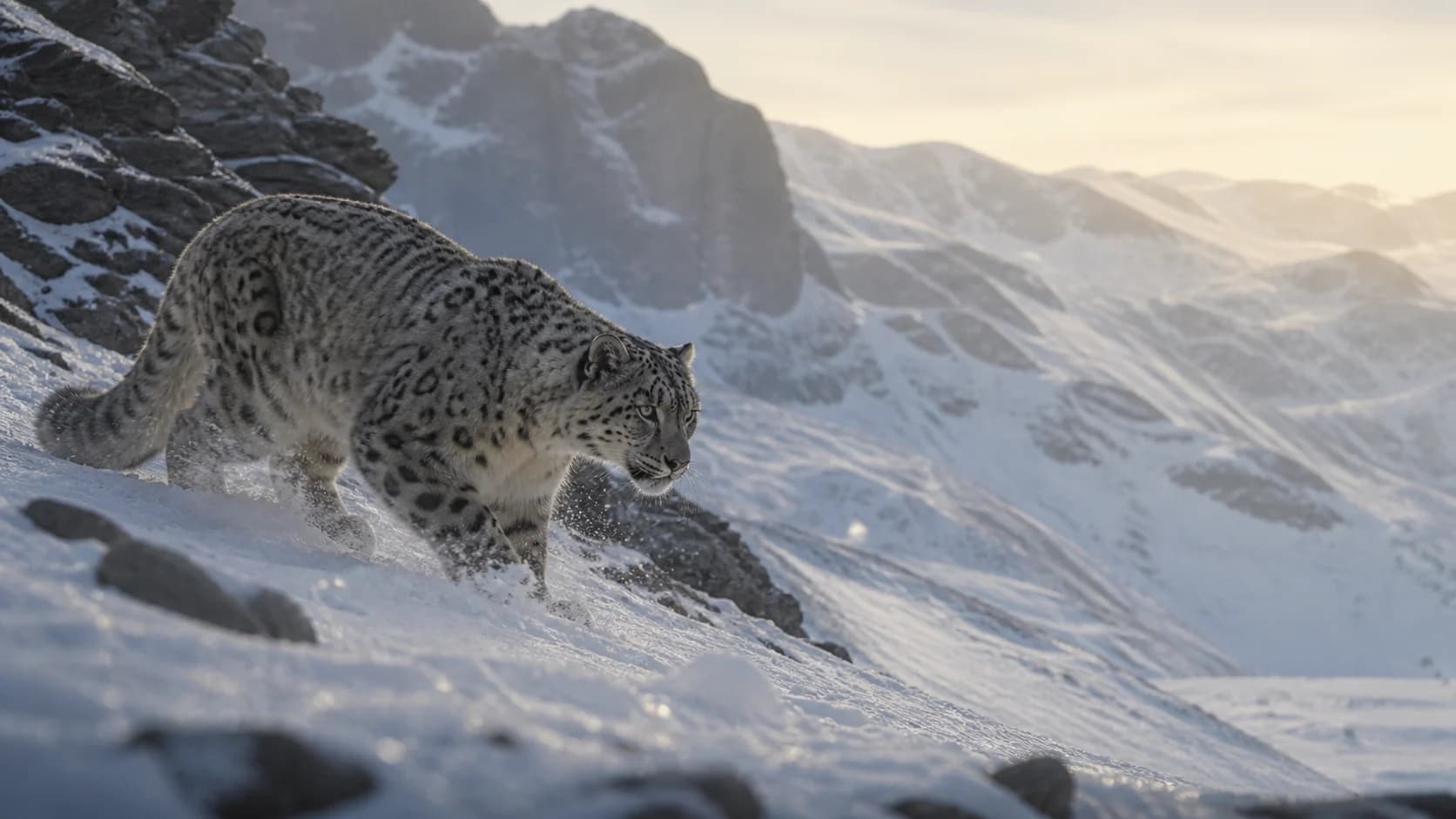
Seedance 2.5 feels ridiculously ahead right now for Wildlife Documentary videos — 30s video, 4K, and up to 50 references
Audit a 10-second Seedance 2.5 wildlife-style sample, learn a three-shot prompt method, and separate 30s, 4K, and 50-reference claims from the evidence.
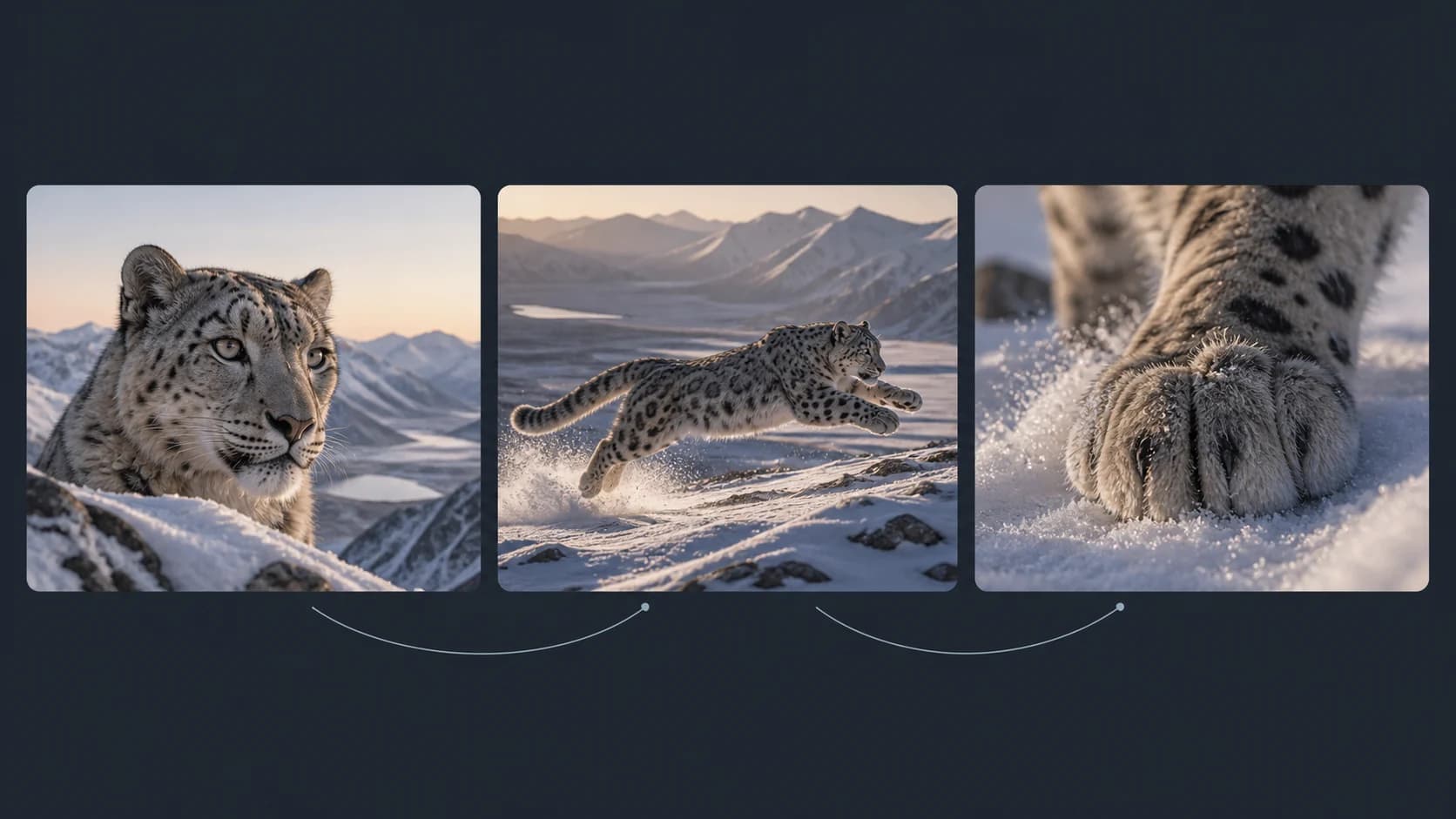
A snow leopard peers over a frozen ridge, its amber eye fills the frame, and then the animal launches across a mountain slope before its claws strike the snow. The sequence looks like a miniature wildlife film. More importantly, it gives us something testable: a 10.154-second media file and a time-coded prompt that can be compared shot by shot.
The source author attributes the sample to Seedance 2.5, but the file itself does not identify its generator. The source page also points to a third-party tool labeled Seedance 2.0. This article therefore treats the clip as a sample attributed to Seedance 2.5, not as an authenticated benchmark. That distinction matters when evaluating both the visuals and the product claims around them.
TL;DR
- The hosted video is 10.154 seconds, 1920×1080, and 30 fps—not a 30-second or 4K deliverable.[2]
- It translates a three-beat prompt into four cleanly edited shots with strong subject, lighting, and environmental continuity.
- The clip does not verify the model source, native 4K, 30-second generation, or a 50-reference workflow.
- Dreamina's current official Seedance 2.5 page separately advertises those capabilities, including up to 50 multimodal inputs.[1]
- The safest description is “AI-generated wildlife-documentary-style visualization,” not wildlife documentation.
What the 10-Second Sample Actually Shows
The downloaded MP4 was fully decoded with FFmpeg without errors. It contains 303 H.264 frames at 30 fps, a 1920×1080 image, and AAC stereo audio. There are no caption streams, visible subtitles, logos, or watermarks. The URL and encoder metadata identify a platform-hosted FFmpeg transcode, not the system that generated the imagery.[2]
Scene-change analysis finds three hard cuts, producing four visible shots:
| Time | What appears on screen | Prompt relationship |
|---|---|---|
| 0.00–1.53s | Snow leopard crouched behind rock and snow, with face and paw in shallow focus | Establishes the ambush beat |
| 1.53–3.70s | Extreme close-up of one amber eye, including a camera-like silhouette in the reflection | Expands the first beat into a second shot |
| 3.70–7.83s | Wide side view of the leopard pushing off and crossing the slope in slow motion | Delivers the burst/action beat |
| 7.83–10.15s | Low macro view of extended claws entering the snow as particles scatter | Delivers the strike beat |
The strongest result is editorial structure. Fur, spots, weather, color, and mountain geography remain coherent enough that the cuts feel intentional rather than assembled from unrelated generations. The leap maintains clear left-to-right action and uses the long tail as a balance cue.
Prompt compliance is not exact. The first beat becomes two shots, paw pads are not clearly shown, rock fragments are hard to distinguish from snow, and the final impact behaves more like a prolonged macro landing than a literal freeze-frame. The prompt's “240fps” instruction describes a slow-motion look; the delivered file is encoded at 30 fps.
A Three-Shot Prompt Method for Wildlife-Style AI Video
A useful prompt gives each shot one narrative job. For a ten-second sequence, the simplest pattern is setup, action, and consequence.
- Lock continuity before writing shots. Define the animal's age, markings, orientation, terrain, weather, light direction, and travel direction once. Repeating contradictory descriptions inside each shot invites drift.
- Give each time block one camera idea and one action. A telephoto setup can establish intent, a lateral tracking shot can carry movement, and a macro insert can show physical consequence. Avoid asking one four-second block to perform several camera moves.
- Describe physics and failure conditions. Specify weight transfer, contact points, particle direction, limb count, and what must not appear. Camera language controls presentation; physical constraints protect credibility.
Timecodes help with pacing, but they do not guarantee exact cuts. If a beat must remain uninterrupted, say “one continuous shot, no insert and no cut.” If delivery frame rate matters, specify it separately from the visual request for slow motion.
To practice the method without assuming this sample's provenance, start from a single still in image-to-video, or assign separate appearance and motion sources in reference-to-video. These are workflow options, not evidence that every upstream Seedance 2.5 limit is available through every product surface.
Where the 30s, 4K, and 50-Reference Claims Begin and End
Dreamina's official Seedance 2.5 product page currently advertises standard generations up to 30 seconds, output described as 4K, and as many as 50 multimodal inputs such as text, scripts, images, video, audio, music, and style guides.[1] Those are official product claims, not measurements produced by this sample. See the separate Seedance 2.5 overview for the product-level feature summary.
The hosted clip demonstrates a ten-second sequence delivered at 1080p. The hosting platform may have downscaled a higher-resolution upload, so this copy neither proves nor disproves a native 4K source. It also contains no evidence of how many references were used. Finally, because the source page points to a Seedance 2.0 tool and the MP4 has no generator signature, attribution remains the poster's claim.
This boundary is simple: cite the official page for available features, and cite the sample only for what can be observed in the sample.
Documentary Style Is Not Documentation
The discussion repeatedly returns to one word: documentary. The clip convincingly borrows documentary grammar—telephoto framing, patient observation, an eye insert, slow-motion action, and a macro impact. Yet the source presents it as generated, not as a recording of a real animal or event. On that account, the sequence is a synthetic representation rather than documentary evidence.
That does not make it useless. It can work for previsualization, fiction, advertising, concept development, or a clearly labeled reenactment. It becomes misleading when presented as evidence of real animal behavior or a real encounter. Wildlife and historical applications also need domain review: visually plausible claws, movement, equipment, or environments can still be factually wrong.
A practical publishing label is direct: AI-generated wildlife-documentary-style visualization. If the sequence illustrates a factual claim, identify it as a reconstruction and have the behavior checked by a qualified subject expert.
Quality-Control Checklist Before Publishing
- Provenance: Can you document the model, version, settings, source assets, and generation date?
- Technical delivery: Verify duration, resolution, frame rate, codec, audio, and full-file decoding.
- Prompt compliance: Compare every requested beat with its actual timing and framing.
- Continuity: Inspect identity, markings, anatomy, light direction, terrain, and motion across cuts.
- Physics: Check weight, contact, gravity, particle behavior, shadows, reflections, and collisions frame by frame.
- Domain accuracy: Ask an expert to review animal behavior or any factual reconstruction.
- Disclosure: Put the AI or reenactment label where viewers will see it before drawing a factual conclusion.
- Claims: Do not use one short sample as proof of untested duration, resolution, cost, or reference capacity.
Original Three-Shot Prompt Template
[Goal]
Create a clearly fictional, wildlife-documentary-style sequence. No captions,
logos, narration, or claim that a real event was recorded.

[Format]
16:9, 10 seconds. Natural color, restrained contrast, realistic motion.

[Continuity anchor]
One adult alpine ibex with a chipped left horn, moving screen-left to
screen-right across a wind-exposed limestone ridge at dawn. Keep markings,
horn shape, body scale, weather, and light direction consistent in every shot.

[00:00–00:03 — Setup]
One uninterrupted medium telephoto shot. The ibex tests loose gravel with one
front hoof. Camera remains steady; no zoom and no cut.

[00:03–00:07 — Action]
One lateral tracking shot as the ibex makes a short controlled jump across a
narrow gap. Show weight transfer from rear legs, a compact airborne posture,
and correct four-limb anatomy.

[00:07–00:10 — Consequence]
Low close-up of the landing hoof compressing gravel. Small stones travel
downslope according to gravity; dust remains subtle. End only after balance
is recovered.

[Negative constraints]
No extra limbs, changing horns, floating debris, camera reflections, extreme
claws, impossible hang time, text, watermark, or unrequested scene change.
The template separates continuity, camera direction, action, and physical constraints. Replace the subject and environment, but preserve that hierarchy.
Frequently Asked Questions
Is the sample 30 seconds long?
No. The hosted file is 10.154 seconds. The 30-second figure belongs to the broader product claim, not this demonstration.
Is the sample native 4K?
The analyzed copy is 1920×1080. The hosting platform may have transcoded a larger source, but the available file cannot verify native 4K generation.
Does the file prove that Seedance 2.5 generated it?
No. The source author provides that attribution, while the MP4 contains no generator identity and the source page points to a Seedance 2.0 tool.
What does “up to 50 references” mean?
Dreamina's official page describes up to 50 multimodal inputs, which may include prompts, scripts, images, video, audio, music, and style guides. It should not automatically be rewritten as 50 reference images.
Why did a three-shot prompt produce four shots?
The generator interpreted the first beat as both a face setup and an eye insert. Explicitly requesting one uninterrupted shot and forbidding inserts can reduce that ambiguity, though it cannot guarantee compliance.
Can an AI wildlife sequence be called a documentary?
It can use documentary style or appear inside a disclosed reconstruction. It should not be presented as recorded evidence of a real animal, place, or event.
Conclusion
The sample's most useful achievement is not proof that Seedance 2.5 is ahead on every specification. It is the conversion of a compact, time-coded brief into a coherent sequence with recognizable film grammar. Creators can learn from that structure while keeping a firm line between observed evidence, official product claims, and synthetic imagery.
References
- [1] Dreamina. Official Seedance 2.5 AI Video Generator. Product claims for duration, multimodal inputs, and output resolution. Accessed August 2026. dreamina.capcut.com/seedance/seedance-2-5
- [2] Seedance2.so editorial technical inspection. Hosted demo MP4. FFprobe metadata and full-stream FFmpeg decode performed August 5, 2026. Analyzed video
Author

Categories
More Posts
Is Seedance 2.0 Chinese? Who Actually Owns It
Seedance 2.0 was built by ByteDance, the company behind TikTok and Douyin. Here is exactly who owns what, where the model runs, and who this website is.
Why Gemini Omni Holds Back Its Most Powerful Trick
Google held back voice editing from Gemini Omni at launch. Here's what the held-back feature would have done, why it matters, and what comes next for it.

Seedance 2.0 prompt engineering: how to write AI video prompts that actually work
Practical tips for writing better AI video generation prompts. Covers structure, camera language, style descriptors, and common mistakes across Seedance, Runway, Sora, and other tools.