

Seedance 2.5 Pricing: Token and Per-Second Costs
Seedance 2.5 pricing explained with official token rates, 5-second 480p and 720p costs, reference-video billing, and a practical project budget method.
As of August 5, 2026, BytePlus lists official Seedance 2.5 pricing for 480p and 720p video generation. Requests without video input cost $10.70 per million tokens, while requests with video input cost $6.40 per million tokens. Those are unit rates, not flat prices per clip. Output duration, resolution, frame rate, and the length of any reference video all affect the final bill.[1]
The useful question is therefore not simply “How much does one Seedance 2.5 video cost?” It is how the token formula turns your exact request into a charge, and how many successful attempts you need before one clip is ready to publish.
TL;DR
- For 480p and 720p output, Seedance 2.5 costs $10.70 per million tokens without video input and $6.40 per million tokens with video input.[1]
- Compared with the matching Seedance 2.0 tiers, the token rates are about 52.9% higher without video input and 48.8% higher with video input.[1]
- BytePlus's five-second examples cost $0.514 at 480p and $1.156 at 720p when the request contains no input video.[1]
- A lower “with video” token rate does not guarantee a cheaper request. Reference-video duration is added to output duration, and BytePlus applies a minimum token threshold to video-input jobs.[1]
- The current Seedance 2.5 price table publishes rates for 480p and 720p only. It does not provide a 2.5 rate for 1080p or 4K.
- Budget against successful generation attempts, not only the number of clips you plan to deliver.
Seedance 2.5 pricing compared with Seedance 2.0
| Billing case | Seedance 2.5 | Matching Seedance 2.0 tier | Change |
|---|---|---|---|
| 480p / 720p, no video input | $10.70 / million tokens | $7.00 / million tokens | +52.9% |
| 480p / 720p, with video input | $6.40 / million tokens | $4.30 / million tokens | +48.8% |
Both generations of pricing come from the same BytePlus ModelArk document. The percentage changes above are calculated from those published rates and rounded to one decimal place.[1]
Two distinctions matter here. First, $10.70 and $6.40 are prices per million tokens, not per second. Second, “with video input” means the request includes a reference video. Text- and image-based requests without an input video fall under the no-video-input rate. The API response and your provider's final invoice remain the source of truth for an individual job.
How the Seedance 2.5 token formula works
BytePlus gives this estimation formula:
Estimated token consumption = (input video duration + output video duration) × output width × output height × output frame rate ÷ 1024
The published Seedance 2.5 examples use 24 fps. Once estimated token consumption is known, the cost calculation is:
Estimated cost = estimated tokens ÷ 1,000,000 × token unit price
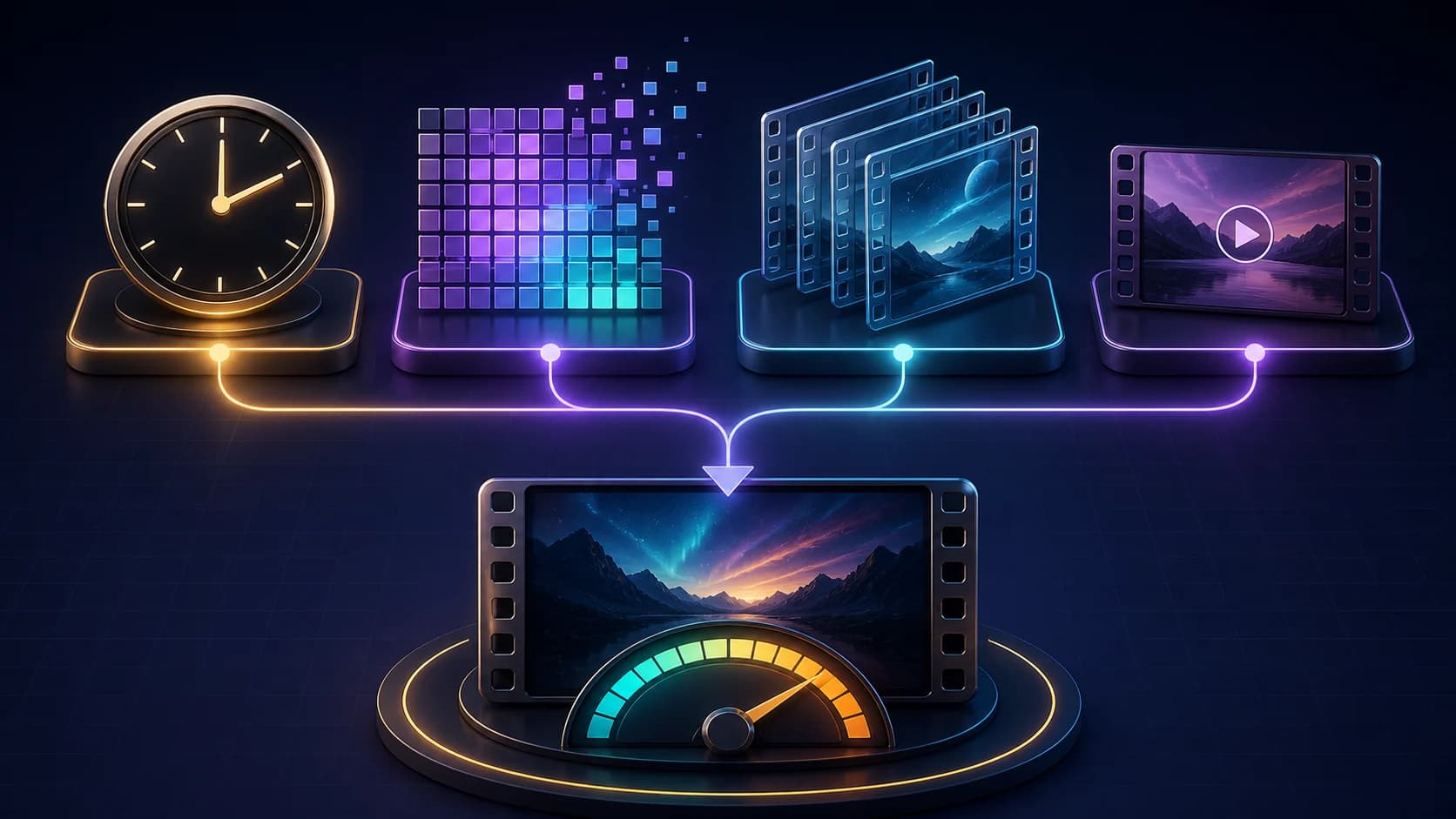
The result scales roughly with output length, pixel count, and frame rate. A video-input request adds one more variable: the duration of the reference footage. Images do not add “input video duration” to this formula, although a third-party platform may still use its own credit system or markup.
A five-second 720p text-to-video calculation
For a 1280 × 720 output at 24 fps and five seconds:
Tokens = 5 × 1280 × 720 × 24 ÷ 1024
       = 108,000

Cost = 108,000 ÷ 1,000,000 × $10.70
     = $1.1556, or about $1.156
That matches the official example and works out to about $0.231 per output second. BytePlus's equivalent five-second 480p example costs $0.514, or about $0.103 per second.[1]
These figures do not create a universal per-second price. Change the resolution, frame rate, input type, or reference duration and the per-second result changes with it.
Why a lower video-input rate can produce a higher bill
The video-input rate falls from $10.70 to $6.40 per million tokens, but the formula adds reference-video duration to output duration. For a five-second 720p output, BytePlus publishes an estimated range of $1.244 to $4.838. The low end covers two- to four-second video inputs, while the high end uses 30 seconds of input footage. Video-input requests also have a minimum token threshold, so very short references cannot be priced by simple linear interpolation.[1]
| Request | Official example cost | Difference from no video input |
|---|---|---|
| No video input | $1.156 | Baseline |
| Short video input | From $1.244 | At least $0.088 more |
| 30-second video input | $4.838 | About 4.18× the baseline |
The bill is determined by unit rate multiplied by billed token volume, not by the unit rate alone. If an image can provide the identity or composition you need, check whether it can replace a video reference. If motion reference is essential, trim away footage that does not contribute to the target shot. Repeatedly sending an unedited 30-second source clip is an expensive way to avoid a few minutes of preparation.
Budget by generation attempts, not finished clips
A deliverable usually takes more than one generation. Suppose a project needs 20 five-second 720p clips and each keeper requires three successful generated versions. The budget must cover 60 billable results, not 20 final exports. BytePlus currently states that it charges only for successfully generated videos; third-party platforms may apply different rules to failures, timeouts, or moderation blocks.[1]
| Workflow | Official example per attempt | Estimated cost for 60 attempts |
|---|---|---|
| No video input | $1.156 | $69.36 |
| Short video input | From $1.244 | From $74.64 |
| 30-second video input | $4.838 | $290.28 |
This arithmetic uses official examples. It does not include a platform markup, subscription structure, tax, currency conversion, or channel-specific refund policy. A practical budget can be built in four steps:
- Fix the output specification: 480p or 720p, clip duration, and frame rate.
- Record the billed duration of every video input, not only the output duration.
- Multiply the per-attempt estimate by the expected number of successful versions and revisions.
- After launch, read
usage.completion_tokensfrom the API response and replace estimates with real consumption. BytePlus says the returned value determines actual token use.[1]
When Seedance 2.5 may justify the higher token rate
The raw rate is clearly higher than Seedance 2.0: about 52.9% more without video input and 48.8% more with video input. That comparison is useful, but it does not measure the cost of obtaining one usable shot.
- If Seedance 2.5 reduces the number of revisions, a higher price per attempt may be offset by fewer attempts.
- If the job is mostly inexpensive drafts or large batches of variations, Seedance 2.0 or another lower-cost model may still fit better.
- If the workflow depends on long video references, shortening those inputs can matter more than the difference between the two token rates.
The cleanest decision is a controlled sample. Run the same prompts and source material through both models, then record successful attempts, keeper rate, and actual tokens. One showcase clip cannot represent production economics.
If you are still comparing capabilities rather than API cost, start with the Seedance 2.5 feature overview. You can also run a small prompt sample in the text-to-video tool. A third-party platform's retail price does not have to match the BytePlus upstream rate, so check the current plans and credit pricing before buying.
What the price table does not establish
The official rate card answers the token-price question, but it does not settle every product question:
- It does not prove that every platform has launched the model. An upstream price can be published before a third-party integration becomes available.
- It does not provide a 1080p or 4K Seedance 2.5 rate. The current 2.5 entry covers 480p and 720p; do not reuse Seedance 2.0's higher-resolution prices.
- It does not turn the estimate into the final bill. Actual consumption comes from
usage.completion_tokens. - It does not define every channel policy. Subscriptions, credits, markups, expiration, and failed-job treatment belong to the platform serving the request.
All prices in this article were checked on August 5, 2026. AI video pricing and availability can change quickly, so record the verification date and revisit the official documentation before procurement or launch.
FAQ
How much does Seedance 2.5 cost per second?
Using BytePlus's five-second examples, a request without video input works out to about $0.103 per second at 480p and $0.231 per second at 720p. Those are example-specific rates, not universal prices. Resolution, frame rate, and video-input duration can change the result.
How much is one five-second Seedance 2.5 video?
Without video input, the official examples are $0.514 at 480p and $1.156 at 720p. A five-second 720p output with video input is estimated at $1.244 to $4.838, mainly because the input-video duration changes.
Why is the token rate lower when a request includes video?
BytePlus publishes two separate token tiers. The lower unit rate does not guarantee a lower total because the input-video duration is added to the billable token calculation and a minimum token threshold applies.
Does an image reference use the video-input rate?
The official pricing distinction is whether the request contains video input. A request using text or images but no input video belongs to the no-video-input category. Confirm the final classification and charge in the API response or provider invoice.
What does 1080p or 4K cost on Seedance 2.5?
As of August 5, 2026, BytePlus's Seedance 2.5 entry publishes rates for 480p and 720p only. Seedance 2.0's 1080p and 4K prices should not be applied to 2.5.
How can I verify the cost of an actual API request?
Use the formula before generation for planning. After the job completes, read usage.completion_tokens from the response and apply the relevant token rate. If you use a third-party platform, also check its credit conversion, markup, and refund rules.
Turn the rate card into a production budget
Seedance 2.5 pricing is now calculable for the published 480p and 720p tiers: $10.70 per million tokens without video input and $6.40 per million tokens with it. The production budget still depends on output pixels, duration, frame rate, reference length, and the number of successful attempts.
Estimate with the official formula, reconcile against usage.completion_tokens, and trim reference footage before scaling a batch. That cost model is far more useful than treating Seedance 2.5 pricing as one fixed number per second.
References
- BytePlus ModelArk. Model pricing — Video generation models. Retrieved August 2026 from docs.byteplus.com/en/docs/ModelArk/1544106
- reAPI. Seedance 2.5 Pricing: 53% More Per Token Than Seedance 2.0. Published August 5, 2026 at reapi.ai/blog/seedance-2-5-pricing-per-token
Author

Categories
More Posts

Higgsfield Alternative: What to Use Instead (2026)
Looking for a Higgsfield alternative? A sourced comparison of pricing, credit expiry, unlimited-mode fine print, and when a focused Seedance studio fits better.

Seedance 2.5 Prompt Guide: Examples & Templates
Learn the official Seedance 2.5 prompt formula with examples for 30-second timing, references, editing, extensions, keyframes, blockouts, audio, and camera.

Seedance 2.0 vs Veo 3: Which AI video generator fits your workflow?
A head-to-head comparison of Seedance 2.0 and Google Veo 3 covering output quality, audio generation, multi-reference input, pricing, and real production use cases for 2026.